Round one:
The high desert is quiet now, but quivers as the breeze blows through sagebrush, bunch grass, and cactus. The rising sun illuminates the vast plains of southern Wyoming, bathing the ground in warm light, pronghorns on the horizon are grazing the sparse vegetation, oblivious to the chaos about to ensue. They said the horses were here last night, but this morning they are nowhere in sight.
The Adobe Town gather aims to remove 1,675 horses over a multi-year management plan for approximately 348,000 acres. This herd management area (HMA) has an appropriate management level (AML) of 259-536 horses; a population that the Bureau of Land Management (BLM) has determined the land can support based on rangeland resource assessments. Today, the estimated population is 2,382, 444% higher than the AML, which is why we're here. To combat overpopulation on public lands, the BLM has been utilizing helicopter gathers to round up excess horses and move them to off range holding facilities.
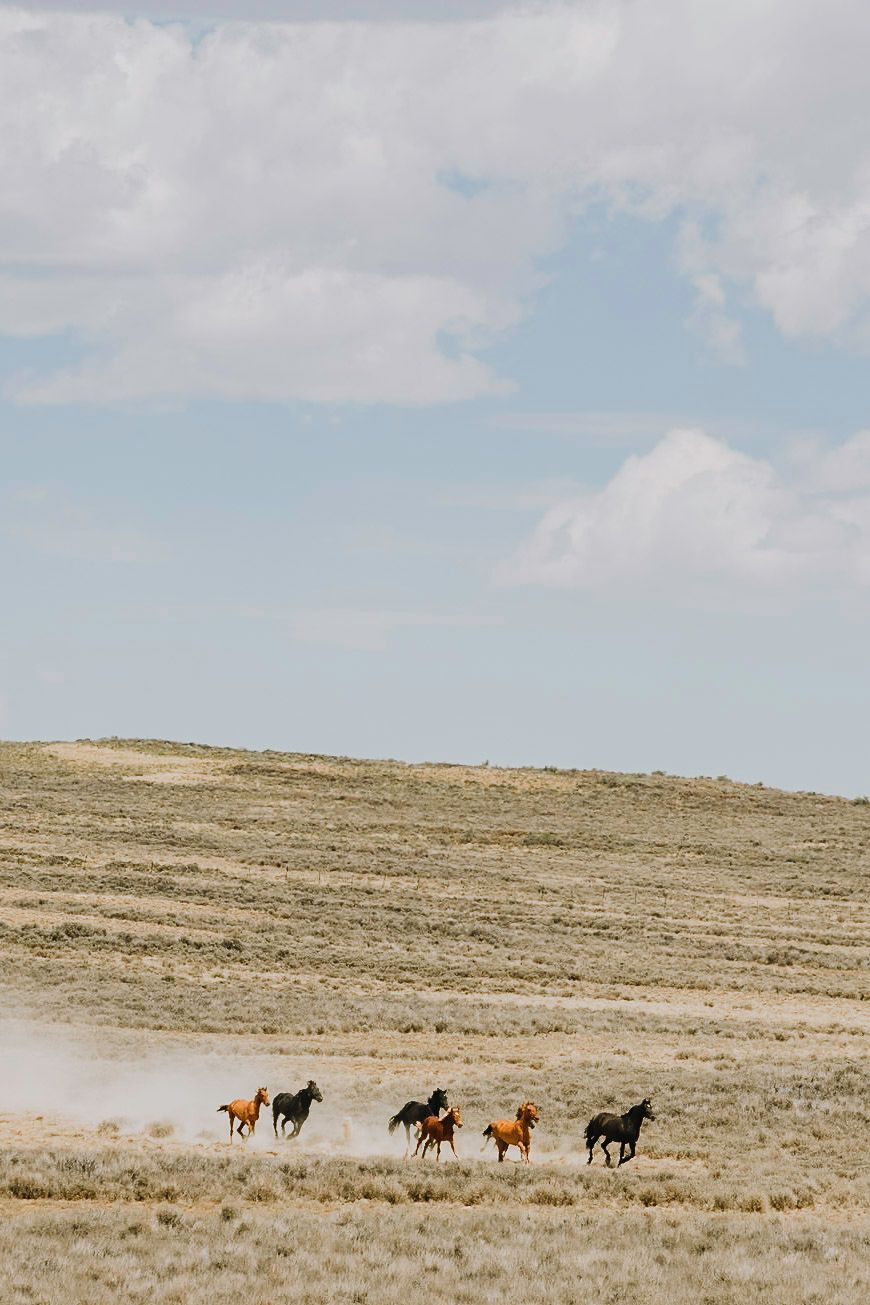
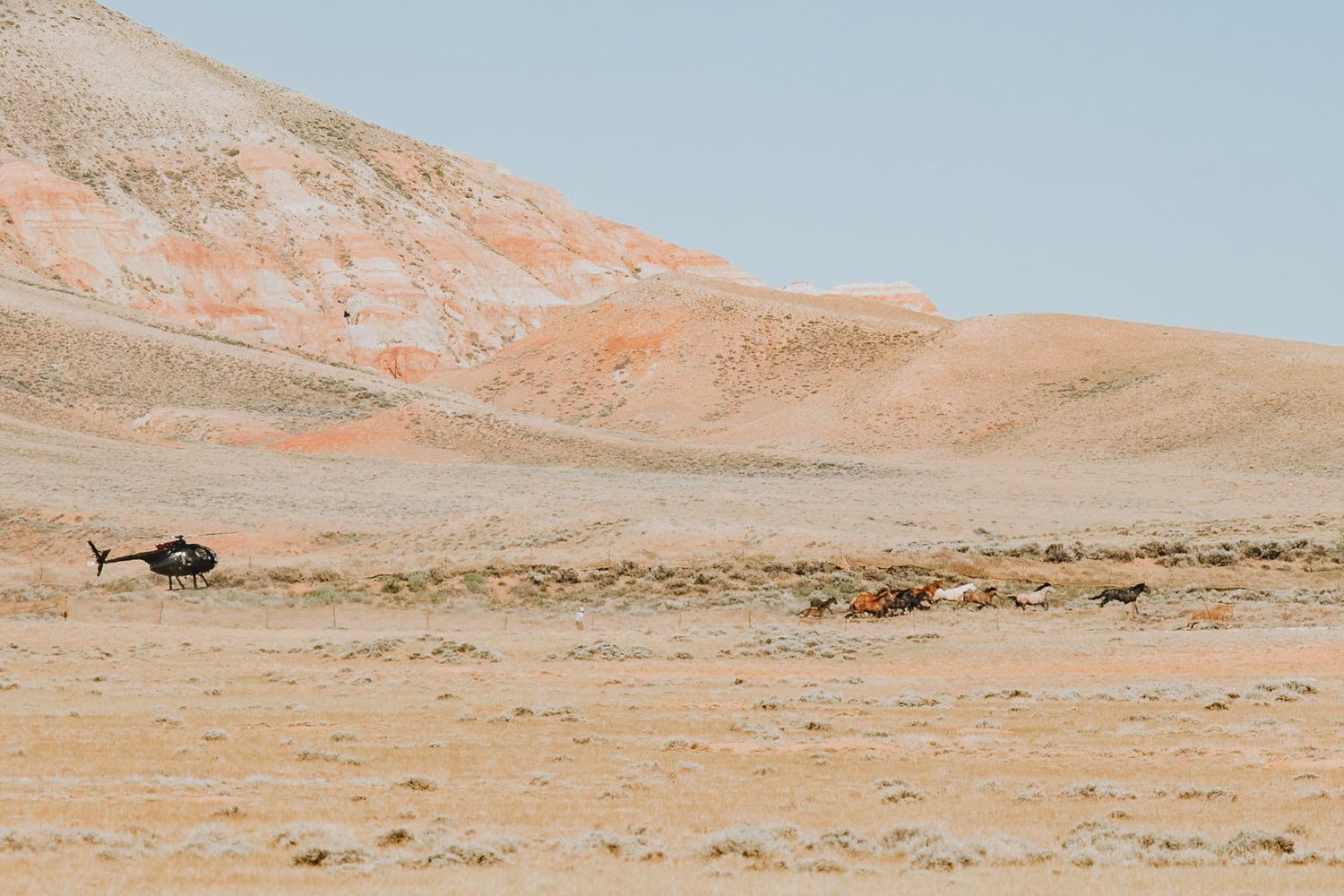
BLM personnel direct us to a little rise covered in sagebrush where we can observe the gather operation on day one of the systematic removal. From our point of view, we can see the trap, a corral that funnels horses into a livestock trailer, set atop a hill to the north, and then the helicopter appears in the souther sky with a herd of horses running ahead. Half a dozen cameras on tripods turn to capture the chase. Rather than pushing the herd straight toward the trap, confusion arises as we witness messy circles made by the pilot. It appears we are watching an amateur at work who does not know how to efficiently move animals causing more panic, exhaustion, and heightening the risk of injury to the horses. Of course from where we stand on the rise, only the distant whir of the helicopter is audible- not the pounding hooves or flared nostrils with labored breath, not the whinnies of frightened foals trying to keep up with their mothers. The path straightens out, 12 or so horses head toward the trap, and the "Judas horse" is released to finish the job of luring them in.
The term "Judas horse" refers to a domestic horse who is held near the trap entry until the wild horses are near. When the herd approaches, the Judas horse is let go and instinctively runs toward the back of the trap where another horse is held offering security to the herd-bound lonesome horse. The wild herd follows Judas into the trap, believing that he will lead them to safety and unknowingly betrayed, lead to captivity instead. But the Judas horse isn't choosing to betray his wild brothers, he knows no better, he is simply an agent of the deception of man.
Round two:
The helicopter disappears for a moment before returning at the rear of another band of wild horses being chased toward the trap. This time the roundup is quicker, fewer horses pushed forward more directly, but one falls behind. Those ahead, follow Judas into the trap and then the helicopter circles back to push the straggler although he is already on his way, trotting, exhausted, but committed to his herd and eventually joining them in the trap. The pilot isn't supposed to push the herd faster than the slowest member, but evidently that wasn't the case this time around, which further upset the observers on the sagebrush rise beside me.
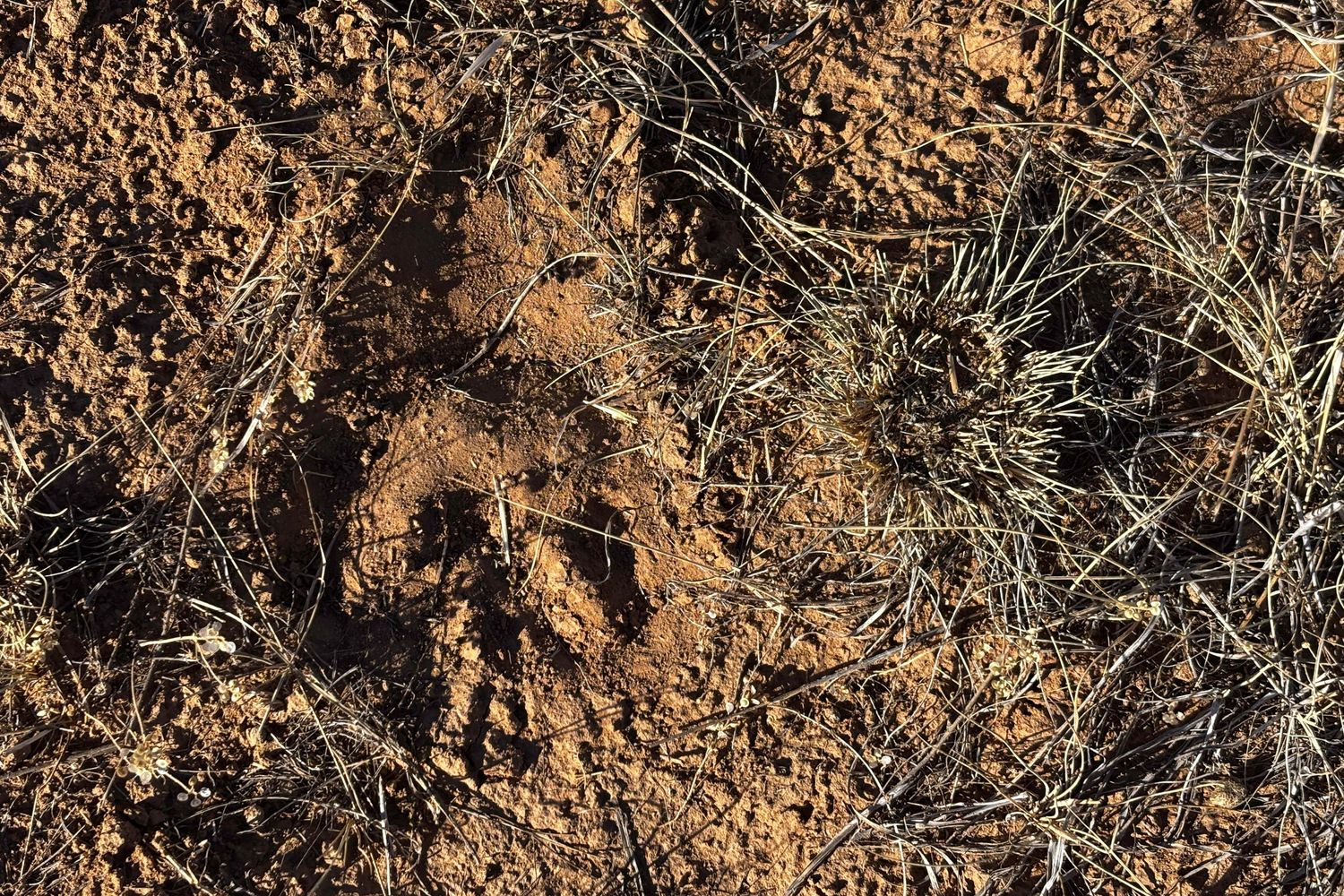
Hoof prints cover the barren ground next to grasses nibbled to the root, brittle and returning to dust, crumbling, disintegrating, like everything out here as we witness the destruction of an ecosystem. At least the sagebrush offers a pleasant aroma to mask the stench of distrust and rage given off by the public observers. Perhaps their rage may be justified as righteous anger over the treatment of these animals, after all they all desire the same thing- for the horses to be free, left alone, undisturbed by such dramatic practices. All are confused and enraged by the pilot's method, or lack thereof, all believing the horses deserve better, all believing they belong here.
The wild horses living across the western United States are not true wild horses, though; they are descendants of domesticated horses. Some herds trace their ancestry back to the Spanish horses that showed up in the Americas about 500 years ago, but most of them have varying degrees of ancestry and influences from various modern breeds that have been turned loose and rewilded. Ben Smith, wild horse specialist and field manager for the Pinedale BLM office, explained that the Adobe Town herds are primarily descended from old military stock of mixed breeds. But horse hoof prints fall adjacent to those of domestic cattle that are permitted to graze on the same swaths of public land. Cattle, which are no more native to this land than these horses, yet granted priority despite being even more destructive. If you turn over a dry cow patty, there is nothing growing beneath it. By contrast, pick through a pile of horse manure, and you will find sprouting new growth as horse's act as seed spreaders, regenerating grazed vegetation.
round three:
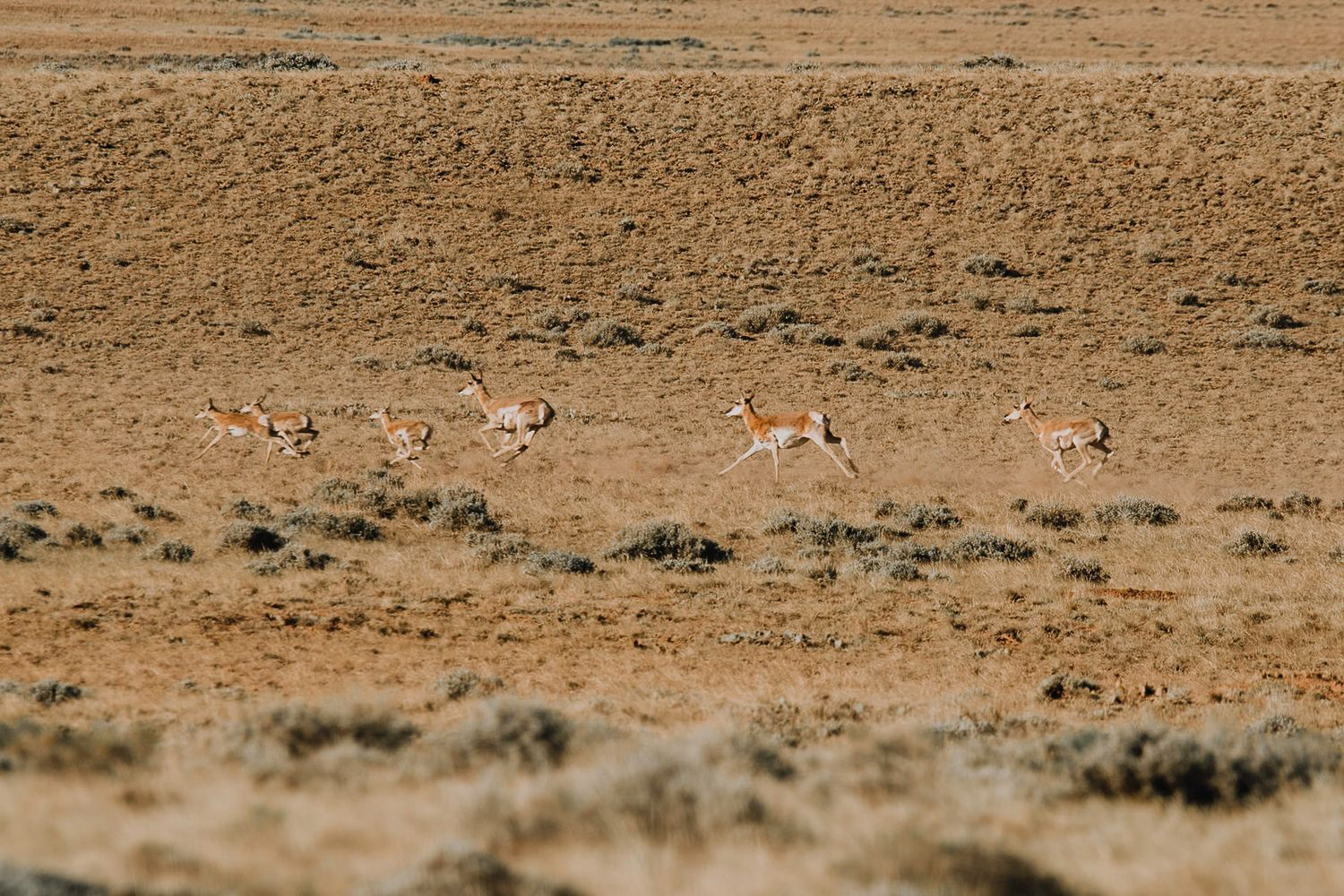
The pronghorn are running at top speed now, something rarely witnessed but often referenced being that they are the second fastest land animal in the world. Even the fawns are keeping up as they flee from the heli overhead. Alongside the pronghorn, I wonder how many more invisible lives are being disrupted. How many other creatures on this landscape are feeling the effects of this calamity? Surely it's not just the pronghorn and horses running; there must be countless rabbits and rodents and birds and bugs all scared and scattering.
At least 14 more horses including 3 foals appear from behind a hill and run straight into the trap. A long pause follows this round of the gather. The air quiets, the dust settles, the earth is still other than the heat waves rippling out over the scene. It is only mid-morning but the day is warming up quickly. We are all waiting, wondering what happens next, then we get word from the contractor hired for the gather- they are finished with this trap site; there are no more horses in the vicinity, but another band of 7 are 8 miles away so they will be setting a new trap to collect those.
While waiting to move to the next trap site, I crunch some numbers. The BLM manages numerous facilities across several states for wild horses and burros with a total capacity for 81,701 head. As of June 2025, the off range population in these facilities is 62,853, leaving room for just 18,848 more horses and burros that are currently on public rangelands. For reference, last year a total of 16,140 horses and burros were rounded up, and in 2022, 20,193 were removed from the range, so theoretically, those 18,000 odd could be gathered and fill the capacity this year. Once those slots are filled and off range holding capacity is met, there will be 54,282 wild horses and burros on range which is still more than twice the total AML of 25,556. What is the plan for the remaining 28,726 excess horses? I pose this question to Jacqueline Alderman, public affairs specialist for the BLM. She explains that the gather operation quotas are adjusted to accommodate the shrinking off range capacity and prioritize HMAs with a greater need for removals based on population and range conditions. But once capacity is met, the program will likely just be paused, "We can't gather more than we can hold," says Alderman.
On average, about 5,300 wild horses and burros are adopted from the BLM and placed in private homes each year. Nearly 300,000 horses and burros have been adopted since the start of the program in 1971, but even these numbers do not relieve the growth rate of on range populations that continue to grow about 20% annually or doubling every 4 years if left unmanaged due to the lack of natural predators.
round four:
We convoy to the next trap site of the day. By now, the early afternoon heat is undeniable. I've got a wet bandana around my neck offering some relief, but I can't ignore the heat waves blurring my camera's vision as I photograph this band of horses standing in their defensive circle, all radiating outward, watching in every direction. The trap is set at the crest of the hill from where they stand, and we are positioned at the base. The helicopter takes flight and so do the horses- running downhill before being cut off and pushed upward again. They see Judas on the ridge line beckoning them and they heed, unaware of the illusion.
The gather operation concludes for the day with respect to the heat. The BLM follows a Comprehensive Animal Welfare Program to protect the welfare of wild horses and burros. The program creates a standardized set of regulations to ensure the safety of the animals, including limits on what temperatures these gathers can occur in. So, the horses are trailered and sent to the temporary holding facility to be vet checked before getting shipped off to a more permanent residence. We are instructed to wait another couple hours to let the horses settle before we visit them there.
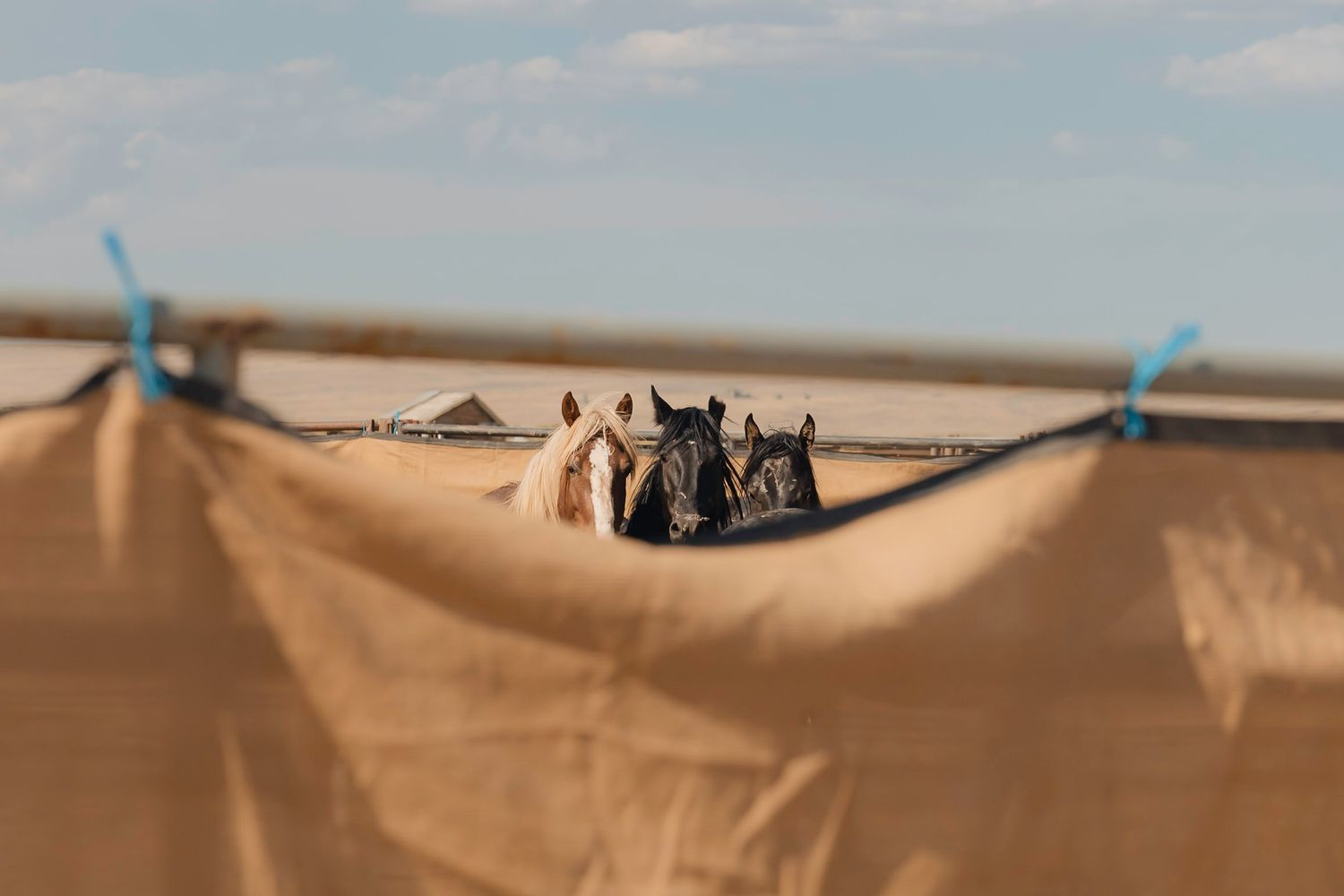
Arriving at the corral, views of the horses behind privacy fences are limited, but occasionally, there's a glimpse of ears over the top, hooves stamping below, or muzzles poking through holes. Though we can't see them well for ourselves, we are told they're all in good condition and there were no injuries, at least not obvious or otherwise reported. The horses will be given some time to settle and get assessed by the veterinarian before being sent elsewhere, where they will join other once-wild horses in the off range population.
Today's total: 38 horses, bringing the total off range population up to 62,891 and costing US taxpayers more than $100million each year. The cost to care for off range equine consumed 66% of the BLM Wild Horse and Burro Program's budget last year. Another 5% ($8million) funded gathers and removals. At the time of writing, the Adobe Town gathers have collected a total of 878 wild horses since beginning the operation on July 15, 2025, surpassing the halfway point to their target within the first 10 days.